The Bunker Diaries
By Stewart Meyer
Beatdom Books
$19.99
The Bunker* is one of the major sites of Beat History, the downtown NYC lair of William Burroughs. Two others I can think of: The Six Gallery** where Howl was first read aloud by Allen Ginsberg. The third is the Beat Hotel in the Latin quarter of Paris,***, where Gregory Corso lived in the attic, Burroughs & Brion Gysin discovered the cut-up method with an accidental slice of newsprint, and Allen Ginsberg passed through at the end of the 1950s.
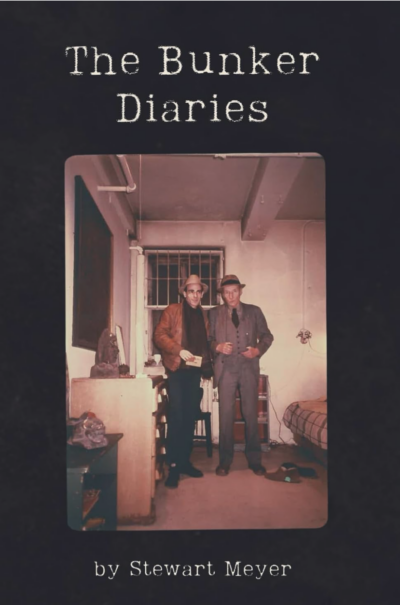
With only Gary Snyder remaining among us, we now must rely on younger friends of the Beats for any direct history. Stewart Meyer hung out at the Bunker quite a bit from 1978 to 1983. This was New York City’s hey-day of punk bands — as well a wide wave of heroin use. Elsewhere in NYC, photographer Nan Goldin’s polaroids capture the baked eyes of cool kids, some on their way to the grave. Junk packets traveled with different colored tape throughout Alphabet City, with names like Black Sunday or Toilet.
Meyer kept good notes, so that much of his recorded (untaped) comments of Burroughs have the stamp of authenticity. The Bunker was a nexus of the who’s who of hip when Meyer spent time there. Meyer gives a vivid account of this converted YMCA, a windowless white-painted concrete, well, bunker, replete with a leftover urinal. The way in was through a steel-plated door; once inside, one felt safe from the scuzzy urban decay of the Bowery.
According to Meyer, Burroughs had returned to opiates after more than 15 years of abstinence. Bill’s books of the sixties describe a successful apomorphine junk cure (a “metabolic regulator”). While reading him on the West Coast at the time, I thought he was still clean, at least of opioids. The new truth slowly leaked out, just as James Grauerholz (RIP), his assistant and editor, whisked Bill away to Lawrence, Kansas before something really serious happened. Meyer’s recollections show that the Kansas move was more drawn out than I had thought, with Grauerholz moving there first, setting up camp, and enticing Burroughs to follow.
Given junk’s prevalence in and out of the Bunker, it is of no surprise that Meyer himself developed a junk habit (he claims from eating opium, not shooting up). Early on, Meyer describes himself as straight. His comfort among so many exclusively homosexual men (Bill, Allen Ginsberg, John Giorno and Grauerholz among others) never comes up in the book. Nobody asked Burroughs about his sex life. Grauerholz was Burroughs’ former lover, unmentioned. Other lovers of record, (such as Cabell McLean and Marcus Ewert) probably passed through the Bunker at this time, but discreetly. Bill first comes across as simply enjoying Meyer’s company. However, Brion Gysin, Bill’s co-creator of the Cut-up Method (and also gay), treats Meyer with haughty disinterest, a predictable response. Frequent guest Allen Ginsberg might have given a more objective read on the Burroughs/Meyer relationship.
Ginsberg, had surprisingly little to say of his forays through the Bunker, but the description of his relationship as student to Bill’s teacher is spot-on.
Meyer had zero interest in Buddhism, (which Ginsberg and Giorno studied seriously at this point) and neither did Burroughs. But Ginsberg always felt Burroughs was a fellow traveler in Buddhism with his “homemade yankee tantra.” Burroughs himself admits a similarity when describing his Do Nothing technique, which allows writing to spontaneously arise. Burroughs later describes John Giorno rushing about, getting ready for his teacher, “the Dalai Lama.” In fact, this would have been Dudjom Rinpoche. Burroughs’ audience with Dudjom Rinpoche on the other half of 222 Bowery (eventually called Yeshe Nyingpo) is described in Matthew Levi Stevens’ Magical Universe of William S. Burroughs. Burroughs was interested in the magical powers lamas such as Ginsberg’s teachers, Rinpoches Chogyam Trungpa and Gelek, supposedly have. Burroughs had a real relationship with Trungpa because of the time he spent teaching at Naropa Institute (later University).
Meyer gives a great sketch of Herbert Huncke, the world’s most famous junkie, when enters the Bunker. Huncke’s original connection with the Beats was through Burroughs; Huncke gave Burroughs his first shot of morphine. Jack Kerouac and Ginsberg were fascinated by Huncke and his tales of the criminal underworld. The three of them often hung out drinking coffee in a number Times Square automats (self-service restaurants with giant banks of vending machines dispensing sandwiches and such, open 24 hours), all long gone. As the story goes, Huncks arrived one night to meet them, sat down and declared,”Man, am I beat.” Kerouac replied, it is said, “I guess we’re a beat generation.” The rest is history.
Huncke, amazingly, lived to the ripe old age of 81; Billy Burroughs Junior’s life was unfortunately a short one. He drank his liver into oblivion, had a liver transplant, and continued to drink until he destroyed that one too. It killed him in 1981, only 34 years old. Billy was the son of Burroughs and Joan Volmer, who died (supposedly) in a William Tell stunt with Burroughs and pistol in Mexico City in 1951, aged 28. Billy’s death was felt all through the Bunker. He had shown some real promise as a writer, completing three novels and two memoirs; my favorite is the posthumously published Cursed At Birth.
During the five year run covered in The Bunker Diaries, Meyer gets divorced and meets his future second wife, Jenny. By the end of the half decade, the book is dominated by his efforts to complete his novel, eventually published as The Lotus Crew, which I found to be very good, not merely Burroughs-derivative, but 100% a reflection of Meyer’s personality. Besides the similarity in subject matter (dope), I enjoyed the precise, often metaphorical imagery. It also suggests that Burroughs intuited Meyer’s talent from the beginning, which gives a better understanding of what Bill liked about him.
The Diaries ends with Burroughs permanently ensconced in Lawrence. He was done with NYC and didn’t like being separated from his cats. I know the feeling.
William S. Burroughs very much admired
(Black’s name likely inspired the current comic actor). Burroughs’ wisdom is in line with the stoicism of Jack Black’s 1926 criminal memoir You Can’t Win, equanimity born from confronting the “algebra of need.” Situation hopeless, but workable. Stewart Meyer has not published another novel after his good luck run. The ups and downs, “the slings and arrows” of good fortune and good drugs, are possibly still his demons.
Good luck with them, sir.
*222 Bowery, NYC
**3115 Fillmore St. San Francisco, original space gone.
***9 Rue Git-le-Coer
Marc Olmsted
Reviews
The pace at which generative video models are evolving is impressive. Wan 2.6 is another strong example of how quality is improving while becoming more accessible. For anyone keeping track of these new tools, https://wan2-6ai.com offers a direct way to test this specific model’s capabilities.
This review made me want to read The Bunker Diaries! It hits the emotional pain points of the book precisely, with delicate and in-depth interpretations of the plot and characters. I can feel the blogger’s genuine reading experience, and it’s already on my book list.
Such a well-written piece, thanks for sharing your insights.
Good read. By the way, for anyone interested in exploring efficient AI image creation tools, I recommend checking out https://nanobanana20.com. It’s very easy to use.
Thanks for sharing this insightful post! The generative AI space is moving incredibly fast right now, especially in video creation. If anyone is looking to experiment with high-quality text-to-video or image-to-video generation, I highly recommend trying out the Wan 2.7 model. I’ve found a very straightforward and accessible platform for it that streamlines the whole process. Definitely worth exploring for creators and developers in this niche. You can check it out here: https://wan2-7ai.com