The moral righteousness of the Western genre with its clear definitions of good vs. evil looks quaint from where we find ourselves in 2014. If heroes are symbols of evolving cultural values, the fact that our pantheon is a line up of likeable “terrorists,” criminals and sleeper agents indicates a national identity in crisis. In this Brave New World where bad is the new good, con artists restore faith in the American dream while PTSD-wracked detectives are today’s guardians of order.
Out of the contradictions and uncertainties of the American situation, the “Southern” has emerged as the “Western” of our time. Ambient and immersive treatments of the historically and geographically baroque south provide a metaphorical space for audiences to contemplate the twin ghost-worlds of our preindustrial past and post-industrial present.
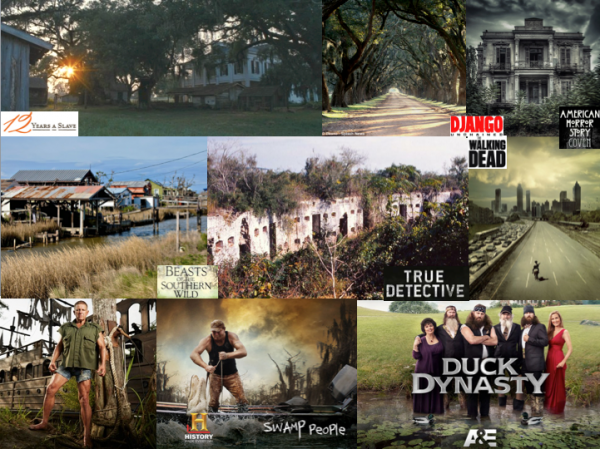
The rise of The Southern: film and television representations of Louisiana or the Deep South
Republic vs. Empire
True Detective engages the symbolism of the Deep South by leveraging the neglected infrastructure and environmental collapse of contemporary Louisiana for its aesthetic language, tonality and plot. From title design onward, the landscape and the ubiquitous oil refineries have dramatic significance on a par with the show’s protagonists as a nonverbal means by which contesting visions of American-ness are played out against each other.
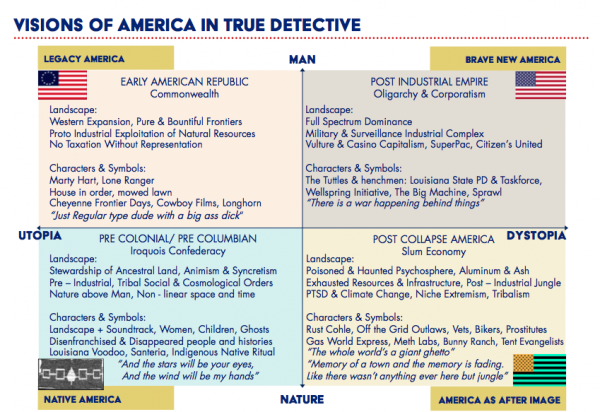
Contesting visions of America in True Detective
Immersive and dramatic aerial shots of the Louisiana bayou are a counterpoint to the heady, philosophical dialectic between Marty and Rust. The borderline between the suburbs and the swamp highlights how fine the line is between civilization and wilderness, directing our attention toward the point at which domesticity ends and ferality begins.
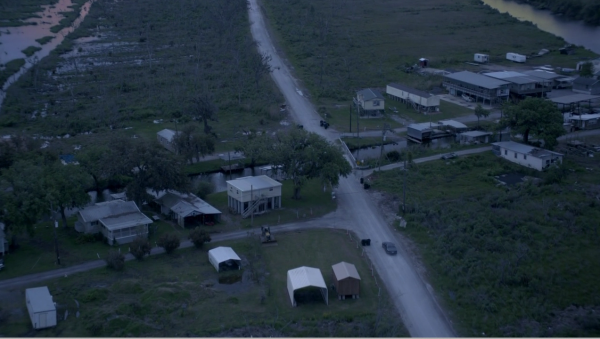
The fine line between wilderness and civilization
Marty Hart is surrounded by the symbols of Legacy America. As a caricature of the “Lone Ranger,” he embodies the values of the Early American Republic with his salt of the earth faith in boundaries, community, and “decency.” In Marty’s worldview, everything has its place. As a self-described “regular guy with a big ass dick,” he even frames marital infidelity as having a role in maintaining the order of his family life. When he gets home from work, he puts his keys in the same spot. He’s territorial–he “likes mowing his own lawn.”
Marty is a “people person,” a domesticated frontiersman & guardian of social order, even after his personal world collapses. When he leaves the Louisiana State PD to start his own small business, “Hart Investigative Solutions,” the singular decorative addition to the office is a “Cheyenne Frontier Days” poster. In the years after his divorce, he eats TV dinners while watching Cowboy movies. When he reunites with Rust to repay their “debt” and focus on solving the case together, he speaks on behalf of Legacy America when he confides, “you end up becomin’ somethin’ you never intended. I guess you never even really know why.”
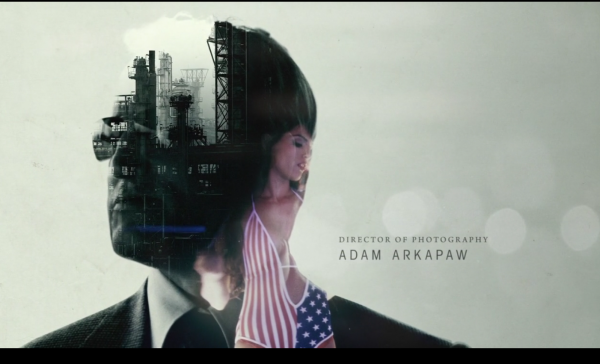
“Illegal business controls America” – Boogie Down Productions (Strip club / oil refinery title
montage)
America as Afterimage
“This place is like somebody’s memory of a town and the memory is fading. Looks like there wasn’t anything here but jungle”
Wilderness is a constant threat to order in True Detective. Neglected weeds grow between the cracks, along deserted freeways and in the broken pavement of abandoned parking lots. Orphaned bikes rust away in indeterminate piles of litter as the whole rottenpost-hurricane mess melts into a lush overgrowth that swallows up traces of a civilization that once was. As if to flaunt the victory of chaos over order, the weeds show America as a forgotten afterimage of itself and reveals it for the “jungle” it has become and was before.
Rust Cohle is the nocturnal opposite of Marty, a symbol of the deterioration and chaos of post-collapse America. In Rust’s worldview, the American Dream was only ever a ghost. Marty describes Cohle‘s “rawboned” ferality by telling the detectives it “took three months to get him over to the house for dinner.” Off the grid and without a television or a family, Rust doesn’t recognize institutional order (“Who the fuck’s Eddy?”) or the myth of progress (“Time is a flat circle”). His home is Spartan, bereft of the domestic trappings of the American dream and its accompanying melodramatic distractions. Abandoned by his mother, raised by a Vietnam vet, and having lost the daughter and wife he had, Cohle’s life as “a cycle of violence and degradation” endows him with a “real mind” for the case.
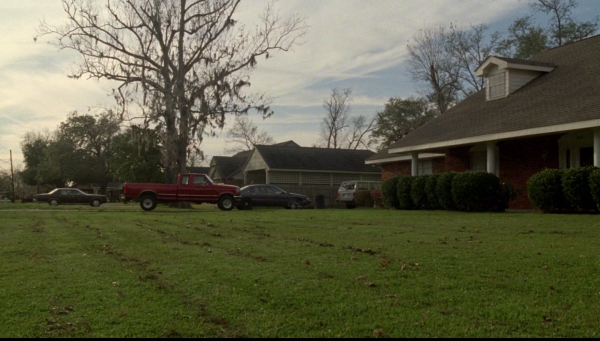
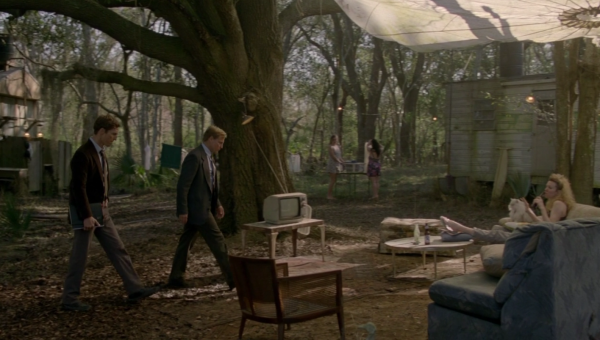
Pre and post collapse visions of America – top: Marty’s Legacy America. “I like mowing my own lawn” “ vs. bottom: “This your place?” / “Its my lease.” A feral living room at the Bunny ranch presents the slum economy waiting at the end of the American Dream.
Dystopian, Post-Collapse America is marked by a new kind of tribalism and “niche extremism” that requires both pre-industrial survival skills like bow hunting, as well as modern military training. Rust’s hypersensitivity endows him with the ability to see beyond things, to “mainline the secret truth of the universe.” His relationship to the “psychosphere” connects him with the cosmological mappings of a pre-colonial landscape.
Rust begins the six-minute tracking shot of the stash house heist by feeling his pulse. The south Texas ghetto scene unfolds in the single shooter gaming aesthetics of Call of Duty, implicitly reframing conventions of the Western shootout with cinematic vocabulary of 21st century warfare. As rogue cop disguised as outlaw disguised as cop, Rust taps into a natural order overriding a parade of illusions. His language devolves into a primal growl as he rides the rising violence in a flow state.
It is only through the hallucinogenic lens of PTSD and synesthesia that Rust can clearly read through the cognitive dissonance of corporate brandspeak (The “Wellspring Initiative”) and see it for what it really is in order to track corruption’s “sprawl.” By using instinct to “read the signs” across the “aluminum and ash” bayou where “nothing grows in the right direction”, Rust maintains a “meta” relationship with social order to subvert and survive it. From his place outside and between, he is uniquely suited to decode the doublespeak of institutional power (The Tuttles, Louisiana State Police Department and the taskforce) and negotiate the terrain of outlaw life (Iron Crusaders, Gas World Express, and drug cartels).
Pipelines covering up this coast like a jigsaw. Place is gonna be under water in 30 years.
Precolonial America–-Do You Believe In Ghosts?
Children signify the future as they convey generational, long-view thinking. The disappearance of women and children in True Detective is tantamount to an end for humanity. The surviving family members of victims are speechless and broken. Trauma, grief and addiction has stopped time for them. They wear their trauma and live half-lives, paralyzed by “cerebral events” and crippled by migraines from mysterious chemicals.
Immersive aerial views of sugar cane fields, cypress groves, and lush jungle are presented from above or in tracking shots and transitions that draw visceral connections between the physical degradation and disappearance of the bayou communities and the ubiquitous presence of oil refineries. In Episode 2 we cut from Ms. Kelly bending over in pain from “headaches that come on like storms” and close ups of her chemically damaged nails to an aerial view of the bayou. The tattered bayou, like the violated bodies of ritual murder victims is “cut up like a jigsaw” by oil pipelines and refineries, doomed to disappear like the voiceless “unsolveds” whose records are “filed in error” and don’t get press.
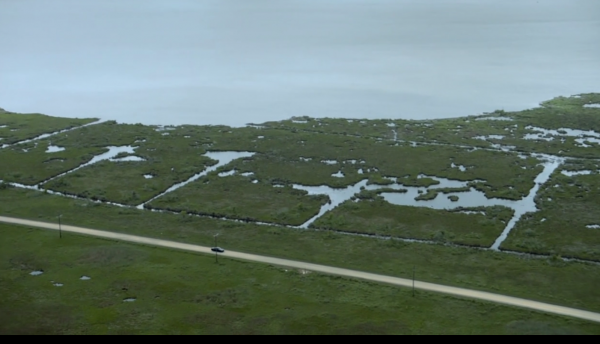
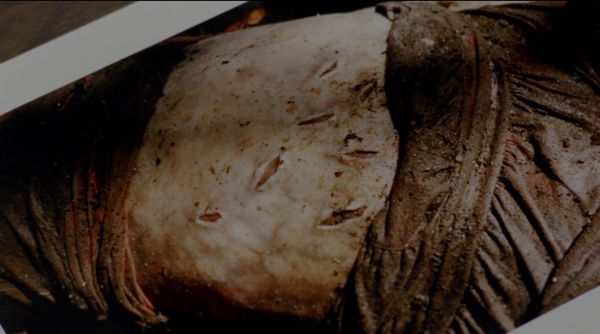
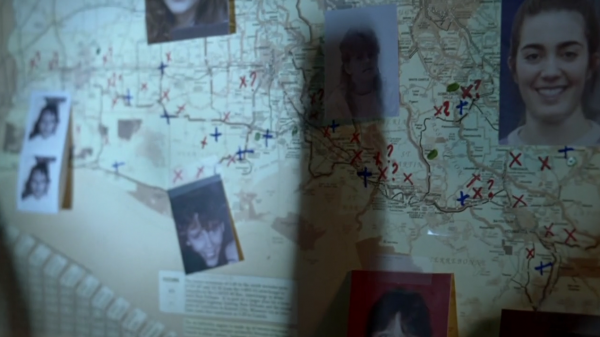
The landscape as symbol of the disappeared and disenfranchised
As a silent witness to atrocity, the landscape becomes the voice of the disappeared, which Rust is able to decipher by listening to other sensorial input ignored by Enlightment prejudice toward visible, observed, reality. By hearing color and tasting sound, he takes guidance from cosmological and metaphysical orders to read the signs of the exhausted, poisoned landscape. The landscape reminds us through its accompanying soundtrack of judgment and redemption, what is “owed by our society for our mutual illusions.”
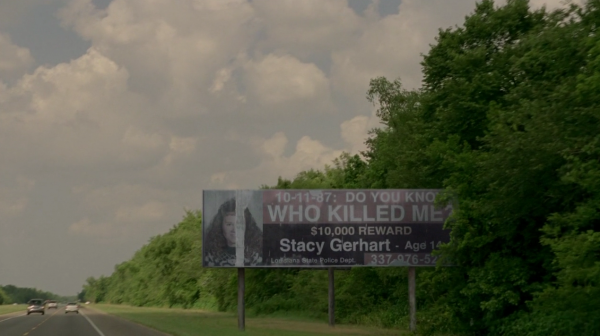
Louisiana’s not land/not water landscape becomes a shattered mirror to project our disappearing future onto. The landscape speaks sensorially, through a soundtrack of slave songs, indigenous symbols, talisman and rituals–traces of cultures and practices disappeared by genocidal economies of Antebellum South and the Western Expansion. When Rust notices a billboard for missing children that reads “Who Killed Me?” the voice of our future and our past speaks simultaneously.
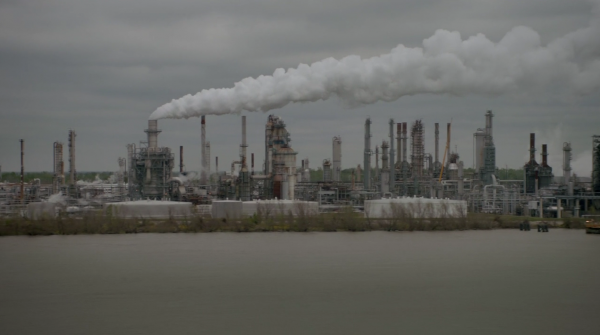
According to Marty, “The Detective’s Curse” is the inability of a detective to read signs right
under his nose because he’s following the wrong clues.
The Detective’s Curse
“It was a horrible, horrible thing. We saw it on TV – what we’re in the clutches of and I prayed and prayed for that [woman’s] family- and its me, its me.”
“Sprawl” is a symbol of the omnipresence of corporate influence in today’s Brave New America. The full spectrum dominance of the Tuttle family tree–their involvement in “a lot of different things” reaching from the police department to the news media–is an oblique reference to the Prism-riddled, crony capitalism of Empire. “How about we track all the missing persons within ten miles of every Walmart? In fact, why don’t we go after Sam Walmart?,” the police chief facetiously asks before dismissing Rust for insubordination.
This sprawling “family tree” is marked on the one hand by the ubiquitous presence of menacing oil refineries, and on the other by the conspicuous absence of evidence for the dead and missing women and children disappearing across bayou country. Metaphors of veils, illusions, and blindness, are woven throughout the series. “We’re in a muddy swamp here and the alligators are swimming all around us…we don’t see em”–says Rust. The hubris of consumerism and its looming debt has made “everybody think they gonna be somebody that they not” and “like a lot of dreams, there’s a monster at the end of it.”
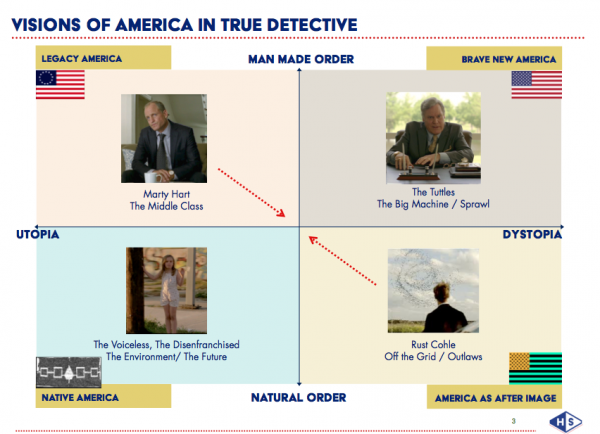
How light won over darkness
“Without me there is no you”
Marty works within the system and then steps out of it, closer toward Rust. Rust, in his older age opens up toward Marty. The intimacy and power of their union toward a single–minded cause not only makes good storytelling, but is good political strategy. As symbols of contrasting worldviews, it is politically significant that Marty and Rust breach their ideological divide to overcome darkness together.
In the real war going on “underneath things” in which values of the Republic are threatened by the private interest of Empire, light just might have a shot against darkness if we are able to trust intuition over appearance and accept both the power and the limits of individualism. But that would take watching our national tragedy unfold on TV as if we had something real at stake.
Marian St. Laurent, founder of Heavy Symbols, LLC is a media consultant and
cultural analyst
Essays
A brilliant analysis, I enjoyed this immensely.
I couldn’t explain to friends exactly how all the elements in True Detective came together to make this show such a powerful and prophetic work of art. thanks to this article, I don’t have to–it’s all right here. what I sensed but couldn’t find the words for. Thank you Marain St. Laurent.
This was excellent, thanks for posting. Makes me want to watch it all again.
So much bullshit you’ve just written. Pos-colonialist indoctrinating Crap. “Genocidal economies” hhahahaha because i’m sure it was paradise before europeans and capitalism hahahaha “poor indians”.
A haunting meditation on American decay—*True Detective* reframes the Western myth through the Southern Gothic lens, revealing a poisoned dreamscape where trauma, corruption, and forgotten souls shape a new kind of heroism. gaming
Really very nice article and very rewarding https://energetic-frog-6grkb6.mystrikingly.com/
The way you describe the “twin ghost-worlds” of the preindustrial past and post-industrial present really captures why the setting of Louisiana feels so suffocatingly heavy in the show. It isn’t just a backdrop; it’s a character that reflects the decay of the American Dream you mentioned. That specific connection between the neglected infrastructure and the moral decay of the protagonists makes the show feel much more prophetic than a standard crime procedural. I’ve often found that when media explores these themes of systemic collapse, it mirrors how we analyze complex systems in other spaces, much like how players look for patterns in Marvel Rivals S8 Tools to understand shifting landscapes. Seeing the oil refineries used as a nonverbal way to signal a “national identity in crisis” is a profound observation. It moves the conversation from simple genre tropes into a much deeper critique of how our environment and our morality are inextricably linked in the modern American psyche.
The way you frame the transition from the “moral righteousness” of the Western to the moral ambiguity of the “Southern” really hits on why the show feels so unsettling. Most viewers focus on the nihilism of Rust Cohle, but your point about the landscape itself—the oil refineries and decaying infrastructure—acting as a character is much more profound. It suggests that the decay isn’t just psychological, but baked into the very geography of the American South. It makes me wonder if our current fascination with these “broken” protagonists is just a reflection of how we perceive our own crumbling social structures. I was actually looking into how character archetypes influence our perception of these themes through an sbti personality test recently, and it’s interesting to see how much we rely on these specific, flawed personality types to make sense of a chaotic world. The idea that the environment serves as a “nonverbal” participant in the narrative explains why the show feels so heavy and immersive even when the dialogue stops.
The way you describe the shift from the moral clarity of the traditional Western to this “Southern” landscape of decay is particularly striking. It feels like the show uses the physical rot of the Louisiana landscape—those oil refineries and crumbling infrastructures—to mirror the internal erosion of the characters’ own moral compasses. I’ve always felt that the setting in True Detective isn’t just a backdrop, but a character that actively participates in the nihilism of the plot. It reminds me of how certain digital ecosystems or complex gaming economies can feel similarly overwhelming and chaotic; I actually used a Blox Fruits Calculator recently to map out value fluctuations in a different kind of high-stakes environment, and it gave me a similar sense of trying to find order within a system that feels fundamentally broken. Your point about “bad being the new good” really hits home—we are increasingly drawn to protagonists who are essentially walking wreckage, perhaps because they reflect our own collective uncertainty about what a “hero” even looks like in a post-industrial society.
The idea that the “Southern” has effectively replaced the “Western” as our modern cultural mirror is a fascinating way to frame the decay seen in the show. I was particularly struck by your point regarding how the neglected infrastructure and oil refineries serve as a nonverbal protagonist; it makes the setting feel less like a backdrop and more like a heavy, suffocating participant in the characters’ moral collapses. It reminds me of how certain environmental details in modern gaming narratives are used to signal a world in decline, a concept I’ve seen discussed on NTE Codes Hub when analyzing immersive world-building. In True Detective, that sense of “environmental collapse” isn’t just aesthetic—it’s a manifestation of that national identity crisis you mentioned. It suggests that we can no longer look to the clear-cut morality of the old frontier because the landscape itself has become too scarred and complicated to support such simple binaries of good versus evil.
The idea that the “Southern” has replaced the “Western” as our primary cultural lens is a fascinating way to frame the show’s heavy atmosphere. I’ve always felt that the decay in the Louisiana landscape wasn’t just a backdrop, but a character itself, and your point about the oil refineries acting as a nonverbal symbol of environmental collapse really hits home. It shifts the focus from a simple crime procedural to a much larger meditation on what we’ve left behind in our rush toward industrialization. It reminds me of how certain aesthetics can linger in our subconscious long after the credits roll, much like the way I use myink ai to capture specific, moody visual concepts that feel more like a memory than a literal image. That “afterimage” quality you mention explains why the show feels so haunting; it’s less about the immediate plot and more about the lingering sense of a country struggling to reconcile its past with a fractured present.
The way you frame the shift from the moral clarity of the Western to the “post-industrial present” of the Southern is such a sharp observation. It’s interesting how the show uses the decaying infrastructure and those looming oil refineries not just as a backdrop, but as a character that actively mirrors the internal collapse of the protagonists. That idea of the landscape acting as a nonverbal participant in the story really explains why the atmosphere feels so suffocating; it’s as if the environment itself is haunted by the contradictions of American progress. I’ve often felt that sense of “ambient decay” in other media as well, and I found a similar perspective on Before You Ink that explores how permanent marks—whether on a landscape or a person—carry that same weight of history and consequence. It makes me wonder if the “afterimage” you mention is less about what we see and more about the permanent, scarred imprint that the past leaves on the present.
The idea that the “Southern” has replaced the Western as our primary metaphorical landscape is a striking way to frame the shift in American storytelling. Your point about the landscape and oil refineries acting as protagonists in their own right really resonates; there is a heavy, almost suffocating sense of environmental decay in the show that makes the setting feel like a character that is actively decaying alongside the social order. It’s as if the geography itself is a manifestation of that “national identity in crisis” you mentioned. I’ve often felt that the tension in these modern narratives comes from the fact that the environment is no longer a neutral backdrop but a witness to our failures. I actually explored how certain melodies can evoke this same sense of haunting nostalgia through Song For You when thinking about how we memorialize our own personal histories. This piece really helped me articulate why the visual language of the Deep South feels so much more prophetic for our current era than the traditional frontier tropes of the past.
The idea that the “Southern” has effectively replaced the “Western” as our primary cultural lens is a striking way to frame the shift in American storytelling. I was particularly struck by your point about how the neglected infrastructure and environmental decay in Louisiana function as a nonverbal character in the show. It moves the setting beyond just a backdrop and turns the landscape into a physical manifestation of that “national identity in crisis” you mentioned. It feels like we are constantly looking at the wreckage of what we used to be while trying to navigate an uncertain future. This sense of atmospheric dread and historical haunting actually reminds me of the mood I get when diving into Halloween Puzzle Games, where the setting is just as much a puzzle to be solved as the actual mystery itself. Your connection between the “twin ghost-worlds” of the past and present perfectly captures why the show feels so much more heavy and prophetic than a standard police procedural.
The way you frame the transition from the Western’s clear moral binary to the “Southern” as a landscape of contradictions is fascinating. I hadn’t quite connected the dots between the decaying infrastructure of Louisiana and the idea of a “post-industrial present” acting as a ghost-world, but it makes perfect sense given how the show uses those oil refineries to dwarf the human protagonists. It suggests that the environment isn’t just a backdrop, but a decaying character itself. I’ve often felt that modern storytelling relies heavily on this sense of atmospheric dread to reflect our own societal anxieties, much like how I look for deeper subtext when exploring lily lovebraids or other niche fan theories to find meaning in complex narratives. Your point about the “hero” evolving into a PTSD-wracked guardian of order really hits home; it feels like we’ve traded the myth of the shining pioneer for a much darker, more realistic reflection of survival in a broken system.
The idea that the “Southern” has replaced the Western as our primary cultural landscape is a striking observation. We often think of the Western as a genre of expansion and clear-cut morality, but your point about the “twin ghost-worlds” of the South captures why a show like True Detective feels so much more suffocating and relevant. The way the decaying infrastructure and oil refineries act as a character themselves—rather than just a backdrop—really highlights that sense of environmental and moral collapse you mentioned. It’s less about the frontier being won and more about the wreckage being left behind. I’ve often spent time dissecting how small, atmospheric details can signal much larger societal shifts, and I found a similar perspective on EveryClue that complements this well regarding how setting dictates narrative tension. Seeing the protagonist’s internal PTSD mirrored in the literal landscape of Louisiana makes the “afterimage” metaphor feel incredibly earned. It isn’t just a crime story; it’s a study of what happens when the American dream becomes a ghost of itself.
The idea that the “Southern” has replaced the “Western” as our primary metaphorical landscape is a fascinating way to frame the decay seen in the show. Your point about the oil refineries and neglected infrastructure acting as nonverbal protagonists really hits home; it suggests that the environment isn’t just a backdrop, but a physical manifestation of a fractured national identity. It reminds me of how certain historical settings in gaming use environmental storytelling to convey a sense of lost glory or systemic rot without saying a word. I actually encountered a similar discussion regarding atmospheric world-building on KCD2Quest that touches on how setting dictates the moral weight of a narrative. When the landscape itself feels haunted by its preindustrial past and post-industrial present, the characters’ struggles feel less like individual choices and more like inevitable symptoms of their surroundings. It makes the “crisis of identity” you mentioned feel much more visceral and inescapable.
The idea that the “Southern” has replaced the “Western” as our primary cultural lens is a striking observation. I hadn’t fully considered how the environmental decay and neglected infrastructure in Louisiana serve as a silent protagonist, but it makes sense—the setting isn’t just a backdrop; it’s a physical manifestation of that “national identity in crisis” you mentioned. It’s fascinating how the show uses oil refineries and post-industrial rot to mirror the internal fragmentation of characters like Rust Cohle. I’ve often felt that modern storytelling relies less on moral clarity and more on this kind of atmospheric dread to reflect our current reality. While researching similar themes of decay and preservation, I stumbled upon how even the way we maintain our physical surroundings, like searching for mobile detailing near me to combat environmental wear, reflects a desire to fight back against that creeping entropy. Your point about the “twin ghost-worlds” of the past and present perfectly captures why the show feels so hauntingly prophetic even years later.
The way you connect the environmental collapse of Louisiana to a broader national identity crisis is a perspective I hadn’t fully articulated before. Your point about the “Southern” replacing the “Western” as our modern metaphorical landscape hits home; it feels like we’ve moved away from the clear-cut morality of the frontier into this much more murky, decaying setting where the landscape itself acts as a character. I was particularly struck by your observation on how the oil refineries function as nonverbal symbols of a contesting vision for America. It reminds me of how certain aesthetic choices in media can signal a deeper societal shift, much like how I’ve noticed specific trends when researching Rivals Tools for analyzing competitive patterns. Seeing the “preindustrial past” clashing with the “post-industrial present” through the lens of True Detective’s visual language makes the show feel less like a crime procedural and more like a haunting autopsy of the American Dream.
The idea that the “Southern” has essentially replaced the “Western” as our primary cinematic landscape for exploring national identity is a fascinating take. I hadn’t previously considered how the environmental collapse and decaying infrastructure in Louisiana serve as more than just a backdrop, but as a character that mirrors the internal fracturing of the protagonists. It’s that tension between the preindustrial ghost-world and our current post-industrial reality that makes the atmosphere feel so suffocatingly real. This shift from the clear-cut morality of old Westerns to these morally gray, “PTSD-wracked” figures really highlights how much our cultural definition of a hero has eroded. I actually found a similar perspective on Rivals Tools that complements this well when discussing how modern narratives often rely on systemic decay rather than individual triumph to drive a story forward. It makes the sense of hopelessness in the show feel much more earned and much less like mere stylistic choice.
The way you frame the Southern landscape not just as a backdrop, but as a character that mirrors the “twin ghost-worlds” of our history, really hits on why the show feels so heavy and claustrophobic. I was particularly struck by your point about the oil refineries and neglected infrastructure acting as a nonverbal language for the plot. It’s that sense of environmental decay that makes the setting feel less like a place and more like a symptom of a larger national crisis. I’ve often found that when media explores these complex, decaying aesthetics, it forces a level of introspection that standard genre tropes avoid. I was actually reading a piece on Wordleos recently that touched on how modern storytelling uses symbolism to reflect shifting cultural identities, and your analysis of the “post-industrial present” provides a perfect cinematic case study for that phenomenon. It makes me wonder if we are moving toward a period where the setting itself becomes the primary driver of morality in television, rather than the individual actions of the protagonists.
The idea that the “Southern” has replaced the “Western” as our primary metaphorical landscape is a striking way to frame the shift in American storytelling. I hadn’t fully considered how the decay of Louisiana’s infrastructure—those oil refineries and neglected spaces—functions as a character in itself rather than just a backdrop. It creates this heavy, suffocating sense of “afterimage” where the ghosts of the preindustrial past are constantly bleeding into our post-industrial present. It reminds me of how certain immersive environments can shape a person’s psychological state; I actually saw a similar discussion on OrbitDash CC regarding how atmosphere dictates player engagement in modern media. In True Detective, that atmosphere isn’t just aesthetic; it’s a manifestation of a national identity that feels increasingly fractured and uncertain. The way the show uses environmental collapse to mirror the internal collapse of the protagonists is what makes it feel so prophetic of our current cultural malaise.
The idea of heroes as symbols of evolving cultural values, particularly the shift towards “likeable terrorists” and criminals, really resonates with me, especially in the context of how we consume media now. It feels like a reflection of a broader societal unease. I found a similar perspective on how cultural shifts influence our archetypes discussed on Pokopia Crystals, though from a different angle.
Your point about the “Southern” genre emerging as the new “Western” is particularly insightful. The way *True Detective* uses the Louisiana landscape not just as a backdrop but as an active participant in the narrative, with its decaying infrastructure and industrial presence, creates this powerful sense of place that mirrors the characters’ internal decay. It’s almost like the environment itself is an afterimage, a haunting reminder of what was and what is.
The observation about the “Southern” genre replacing the “Western” as our contemporary cultural touchstone really resonates with me, especially in how it uses the Deep South as a metaphorical space. Your point about the shift from clear moral lines to a more ambiguous landscape where “bad is the new good” feels particularly apt when looking at characters like Rust Cohle. It’s fascinating how the show uses the actual environment – the decaying infrastructure and industrial blight of Louisiana – to mirror the internal decay and fractured identity of its characters. It makes me wonder how depictions of physical landscapes in media reflect, or even shape, our collective sense of national identity. I was trying to estimate materials for a small project recently and came across a useful Concrete Calculator, which made me think about how even seemingly straightforward calculations can have a real-world impact, much like how the show uses its setting to profound effect.
Image to Image AI is a powerful online tool that transforms any picture into a new, enhanced, or stylized version using cutting-edge AI technology.
Restore Old Photos is a professional service that brings your precious memories back to life with advanced photo restoration technology
Concrete Calculator helps contractors and DIY builders reduce waste and plan projects with precise material estimates.
Ai Photo Enhancer is a fast and easy AI-powered photo enhancement tool.
This online square face generator is the best Picrew alternative in English — create adorable square face icons for social media and game development
Image to Image AI offers fast, high-quality image transformation, making it perfect for creators, designers, and everyday users who need instant visual upgrades.
Restore Old Photos helps families, historians, and photographers preserve memories by bringing old pictures back to life.
https://www.thebuyerpro.com
The Buyer Pro is a buyer-focused website designed to support purchase decisions and product research. It can be used for shopping guidance, comparisons, and consumer-oriented content. The site is suitable for promotional campaigns in commerce and product discovery.
https://www.global-luxstudio.com
Global Lux Studio is a premium-style website focused on luxury, fashion, and high-end presentation. It is a suitable brand for audiences interested in elegant products and refined visual identity. The site can be positioned for upscale promotional campaigns.
https://www.spottheluxe.com
Spot The Luxe is a fashion and luxury-oriented website that fits premium lifestyle positioning. It can be used to attract audiences interested in style, accessories, and upscale brand content. The site has strong potential for luxury-focused promotion.
https://www.forgecalcs.com
Forge Calcs is a calculation-focused website designed to support users who need fast and practical online math tools. It can be used for general estimating, planning, or task-specific conversions. The site is suitable for a wide range of utility-based promotional use cases.
https://www.pngcropper.com
PNG Cropper is an online image tool that helps users crop PNG files quickly and easily. It is useful for designers, social media users, and anyone editing transparent images. The tool provides a simple solution for fast visual adjustments.
https://www.daogoupro.com
Daogou Pro is a shopping and buying-assistance platform focused on cross-border purchasing and daigou services. It is useful for users looking for help with sourcing products, shopping internationally, or finding curated buying solutions. The site fits well for premium shopping and trade-related promotion.
https://www.myglobalfind.com
My Global Find is a search-oriented website designed to help users discover and access information more efficiently. It can be positioned as a general utility site for lookup, discovery, and broad internet navigation. The brand has flexible promotional potential across multiple content types.
https://www.yourstylepath.com
Your Style Path is a style-focused website designed to help users explore fashion direction and personal image. It is suitable for audiences interested in outfits, visual identity, and lifestyle inspiration. The brand works well for fashion and self-expression promotion.
https://www.uniscijpeg.com
This website appears to focus on JPEG-related image handling or conversion tools. It is useful for users who need simple visual file processing and quick image format tasks. The site fits within the image utility and productivity category.
https://www.therefinespot.com
The Refine Spot is a curated lifestyle and premium-style website with a refined brand image. It fits audiences looking for tasteful, polished, and selective content across lifestyle or shopping themes. The site can support upscale promotional positioning.
https://www.spottheluxe.com
Spot The Luxe is a fashion and luxury-oriented website that fits premium lifestyle positioning. It can be used to attract audiences interested in style, accessories, and upscale brand content. The site has strong potential for luxury-focused promotion.
https://www.asphaltcalculatorprice.com
This website provides a practical asphalt calculator for estimating volume, weight, and cost for paving projects. It is useful for driveways, roads, parking lots, and other construction jobs where accurate asphalt planning matters. Users can quickly calculate material needs and better control project budgets.
https://www.yourstylepath.com
Your Style Path is a style-focused website designed to help users explore fashion direction and personal image. It is suitable for audiences interested in outfits, visual identity, and lifestyle inspiration. The brand works well for fashion and self-expression promotion.
interested in outfits
https://www.domainextractoronline.com
This website offers a useful online tool for extracting domains from text, lists, or URLs. It is especially practical for SEO, web scraping, data cleaning, and website management tasks. The tool is simple, efficient, and valuable for professionals who work with large amounts of web data.
I connected “America as Afterimage in True Detective – Marian St. Laurent – Essays – My Site” with Hello3D while reading this. The connection is mostly about turning a loose idea into a clearer visual example. It made the article more useful to me.
https://www.therefinespot.com
The Refine Spot is a curated lifestyle and premium-style website with a refined brand image. It fits audiences looking for tasteful, polished, and selective content across lifestyle or shopping themes. The site can support upscale promotional positioning.
https://www.toolhubkit.com
Tool Hub Kit is a multipurpose utility website that brings together practical tools in one place. It is suitable for users who want quick access to helpful online tools without switching websites. The brand works well for general utility and productivity promotion.
Awesome write-up! I love the points you made. If you’re into casual games, you might also enjoy head-football – the best head football action on the web.
Great post! I really enjoyed reading it. By the way, if you like fun browser games, you should check out head-football – amazing head-to-head soccer action online.
I really appreciate your take on how the Western genre’s moral landscape has shifted. It’s fascinating to think about how our cultural heroes have changed. I wonder how this new perspective would translate into visual storytelling. If you’re looking to expand on these ideas in a more immersive way, check out the AI video extension tool. It can turn short videos into longer, more in-depth content that might just bring these concepts to life.
I really appreciate your take on how the Western genre’s moral landscape has shifted. It’s fascinating to think about how cultural values are reflected in our heroes. I’ve always been intrigued by the evolving nature of these archetypes. Your mention of the “Southern” as the new “Western” got me thinking. If you’re into exploring these complex themes further, check out Far Far West Guides. It has all sorts of codes and guides related to similar concepts in a different fictional realm.
Great article, thank you for sharing! The topic is genuinely interesting and the way you explained it makes it easy to follow. I’ll definitely keep this in mind.
https://www.phonecasescustom.com
I can see this being bookmarked by people who need a reliable online tool. It does what it promises and keeps the process uncomplicated.
https://www.firetextgenerator.com
I appreciate when a site gets straight to the point like this. It feels organized, helpful, and not overloaded with unnecessary distractions.